ID:BUB1_HUMAN DESCRIPTION: RecName: Full=Mitotic checkpoint serine/threonine-protein kinase BUB1; Short=hBUB1; EC=2.7.11.1; AltName: Full=BUB1A; FUNCTION: Serine/threonine-protein kinase that performs 2 crucial functions during mitosis: it is essential for spindle-assembly checkpoint signaling and for correct chromosome alignment. Has a key role in the assembly of checkpoint proteins at the kinetochore, being required for the subsequent localization of CENPF, BUB1B, CENPE and MAD2L1. Required for the kinetochore localization of PLK1. Plays an important role in defining SGOL1 localization and thereby affects sister chromatid cohesion. Acts as a substrate for anaphase-promoting complex or cyclosome (APC/C) in complex with its activator CDH1 (APC/C-Cdh1). Necessary for ensuring proper chromosome segregation and binding to BUB3 is essential for this function. Can regulate chromosome segregation in a kinetochore-independent manner. Can phosphorylate BUB3. The BUB1-BUB3 complex plays a role in the inhibition of APC/C when spindle-assembly checkpoint is activated and inhibits the ubiquitin ligase activity of APC/C by phosphorylating its activator CDC20. This complex can also phosphorylate MAD1L1. Kinase activity is essential for inhibition of APC/CCDC20 and for chromosome alignment but does not play a major role in the spindle-assembly checkpoint activity. Mediates cell death in response to chromosome missegregation and acts to suppress spontaneous tumorigenesis. CATALYTIC ACTIVITY: ATP + a protein = ADP + a phosphoprotein. ENZYME REGULATION: Autophosphorylated when the cells enters mitosis. SUBUNIT: Interacts with BUB3 and CASC5. Interacts (when phosphorylated) with PLK1. The BUB1-BUB3 complex interacts with MAD1L1. Interacts with SV40 Large T antigen; this interaction induces activation of a DNA damage response and promotes p53/TP53 stabilization and phosphorylation (Probable). SUBCELLULAR LOCATION: Nucleus. Chromosome, centromere, kinetochore. Note=Nuclear in interphase cells. Accumulates gradually during G1 and S phase of the cell cycle, peaks at G2/M, and drops dramatically after mitosis. Localizes to the outer kinetochore. Kinetochore localization is required for normal mitotic timing and checkpoint response to spindle damage and occurs very early in prophase. AURKB, CASC5 and INCENP are required for kinetochore localization (By similarity). TISSUE SPECIFICITY: High expression in testis and thymus, less in colon, spleen, lung and small intestine. Expressed in fetal thymus, bone marrow, heart, liver, spleen and thymus. Expression is associated with cells/tissues with a high mitotic index. INDUCTION: Inhibited by phorbol 12-myristate 13-acetate (PMA). DOMAIN: The KEN box is required for its ubiquitination and degradation. DOMAIN: BUB1 N-terminal domain directs kinetochore localization and binding to BUB3. PTM: Phosphorylated upon DNA damage, probably by ATM or ATR. Upon spindle-assembly checkpoint activation it is hyperphosphorylated and its kinase activity toward CDC20 is stimulated. Phosphorylation at Thr-609 is required for interaction with PLK1, phosphorylation at this site probably creates a binding site for the POLO-box domain of PLK1, thus enhancing the PLK1-BUB1 interaction. PTM: Ubiquitinated and degraded during mitotic exit by APC/C-Cdh1. SIMILARITY: Belongs to the protein kinase superfamily. Ser/Thr protein kinase family. BUB1 subfamily. SIMILARITY: Contains 1 BUB1 N-terminal domain. SIMILARITY: Contains 1 protein kinase domain.
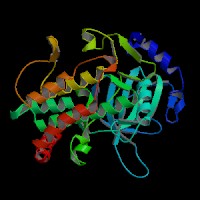
ModBase Predicted Comparative 3D Structure on O43683
Front
Top
Side
The pictures above may be empty if there is no ModBase structure for the protein. The ModBase structure frequently covers just a fragment of the protein. You may be asked to log onto ModBase the first time you click on the pictures. It is simplest after logging in to just click on the picture again to get to the specific info on that model.
Other Names for This Gene
Press "+" in the title bar above to open this section.
Methods, Credits, and Use Restrictions
Press "+" in the title bar above to open this section.