Human Gene ZNRF1 (ENST00000567962.5) Description and Page Index
Description: E3 ubiquitin-protein ligase that mediates the ubiquitination of AKT1 and GLUL, thereby playing a role in neuron cells differentiation. Plays a role in the establishment and maintenance of neuronal transmission and plasticity. Regulates Schwann cells differentiation by mediating ubiquitination of GLUL. Promotes neurodegeneration by mediating 'Lys-48'-linked polyubiquitination and subsequent degradation of AKT1 in axons: degradation of AKT1 prevents AKT1-mediated phosphorylation of GSK3B, leading to GSK3B activation and phosphorylation of DPYSL2/CRMP2 followed by destabilization of microtubule assembly in axons (Probable). (from UniProt Q8ND25) Gencode Transcript: ENST00000567962.5 Gencode Gene: ENSG00000186187.12 Transcript (Including UTRs) Position: hg38 chr16:74,999,345-75,108,028 Size: 108,684 Total Exon Count: 5 Strand: + Coding Region Position: hg38 chr16:74,999,672-75,106,539 Size: 106,868 Coding Exon Count: 4
ID:ZNRF1_HUMAN DESCRIPTION: RecName: Full=E3 ubiquitin-protein ligase ZNRF1; EC=6.3.2.-; AltName: Full=Nerve injury-induced gene 283 protein; AltName: Full=Zinc/RING finger protein 1; FUNCTION: E3 ubiquitin-protein ligase that mediates the ubiquitination of AKT1 and GLUL, thereby playing a role in neuron cells differentiation. Plays a role in the establishment and maintenance of neuronal transmission and plasticity. Regulates Schwann cells differentiation by mediating ubiquitination of GLUL. Promotes neurodegeneration by mediating 'Lys-48'-linked polyubiquitination and subsequent degradation of AKT1 in axons: degradation of AKT1 prevents AKT1-mediated phosphorylation of GSK3B, leading to GSK3B activation and phosphorylation of DPYSL2/CRMP2 followed by destabilization of microtubule assembly in axons (Probable). PATHWAY: Protein modification; protein ubiquitination. SUBUNIT: Interacts with AKT1, GLUL and TUBB2A (By similarity). INTERACTION: P51668:UBE2D1; NbExp=4; IntAct=EBI-2129250, EBI-743540; P62837:UBE2D2; NbExp=4; IntAct=EBI-2129250, EBI-347677; P61077:UBE2D3; NbExp=3; IntAct=EBI-2129250, EBI-348268; Q9Y2X8:UBE2D4; NbExp=3; IntAct=EBI-2129250, EBI-745527; P51965:UBE2E1; NbExp=3; IntAct=EBI-2129250, EBI-348546; P61088:UBE2N; NbExp=3; IntAct=EBI-2129250, EBI-1052908; Q13404:UBE2V1; NbExp=2; IntAct=EBI-2129250, EBI-1050671; SUBCELLULAR LOCATION: Endosome. Lysosome. Membrane; Peripheral membrane protein. Cytoplasmic vesicle, secretory vesicle, synaptic vesicle membrane; Peripheral membrane protein (Potential). Note=Associated with synaptic vesicle membranes in neurons. TISSUE SPECIFICITY: Expressed primarily in the nervous system, with expression higher in developing brain relative to adult. Expressed at low levels in testis and thymus. DOMAIN: The RING-type zinc finger domain is required for E3 ligase activity (By similarity). SIMILARITY: Contains 1 RING-type zinc finger.
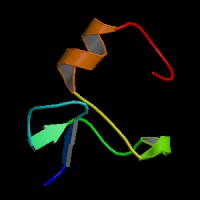
ModBase Predicted Comparative 3D Structure on Q8ND25
Front
Top
Side
The pictures above may be empty if there is no ModBase structure for the protein. The ModBase structure frequently covers just a fragment of the protein. You may be asked to log onto ModBase the first time you click on the pictures. It is simplest after logging in to just click on the picture again to get to the specific info on that model.