Press "+" in the title bar above to open this section.
Comments and Description Text from UniProtKB
ID:T22D3_HUMAN DESCRIPTION: RecName: Full=TSC22 domain family protein 3; AltName: Full=DSIP-immunoreactive peptide; Short=Protein DIP; Short=hDIP; AltName: Full=Delta sleep-inducing peptide immunoreactor; AltName: Full=Glucocorticoid-induced leucine zipper protein; Short=GILZ; AltName: Full=TSC-22-like protein; AltName: Full=TSC-22-related protein; Short=TSC-22R; FUNCTION: Protects T-cells from IL2 deprivation-induced apoptosis through the inhibition of FOXO3A transcriptional activity that leads to the down-regulation of the pro-apoptotic factor BCL2L11. In macrophages, plays a role in the anti-inflammatory and immunosuppressive effects of glucocorticoids and IL10. In T-cells, inhibits anti-CD3-induced NFKB1 nuclear translocation. In vitro, suppresses AP1 and NFKB1 DNA-binding activities (By similarity). SUBUNIT: Can form homodimers, however it is likely to function as a monomer. Interacts with AP1 (By similarity). Interacts with NFKB1. TISSUE SPECIFICITY: Expressed in brain, lung, spleen and skeletal muscle. Lower levels detected in heart and kidney. Not detected in the pancreas. In non-lymphoid tissues, in the absence of inflammation, the major source of constitutive expression is the macrophage lineage. Also expressed in cells from different hemopoietic cell lineages, including bone marrow cells, CD34+ stem cells, mature B- and T-cells, monocytes and granulocytes. Down- regulated in activated macrophages from inflammatory lesions of delayed-type hypersensitivity (DTH) reactions, such as in tuberculosis and in Crohn disease, whereas in Burkitt lymphoma, persists in macrophages involved in the phagocytosis of apoptotic malignant cells. INDUCTION: By glucocorticoids in lymphoid cells and upon IL4, IL10, IL13 or glucocorticoid treatment in monocyte/macrophage cells. Transiently induced by IL2 deprivation in T-cells. DOMAIN: The leucine-zipper is involved in homodimerization (By similarity). SIMILARITY: Belongs to the TSC-22/Dip/Bun family. SEQUENCE CAUTION: Sequence=AAH18148.3; Type=Erroneous initiation; Sequence=CAA90644.1; Type=Erroneous initiation; Sequence=CAB53669.1; Type=Frameshift; Positions=4;
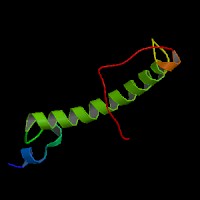
ModBase Predicted Comparative 3D Structure on Q99576
Front
Top
Side
The pictures above may be empty if there is no ModBase structure for the protein. The ModBase structure frequently covers just a fragment of the protein. You may be asked to log onto ModBase the first time you click on the pictures. It is simplest after logging in to just click on the picture again to get to the specific info on that model.