Press "+" in the title bar above to open this section.
Comments and Description Text from UniProtKB
ID:GNAI3_HUMAN DESCRIPTION: RecName: Full=Guanine nucleotide-binding protein G(k) subunit alpha; AltName: Full=G(i) alpha-3; FUNCTION: Guanine nucleotide-binding proteins (G proteins) are involved as modulators or transducers in various transmembrane signaling systems. G(k) is the stimulatory G protein of receptor- regulated K(+) channels. The active GTP-bound form prevents the association of RGS14 with centrosomes and is required for the translocation of RGS14 from the cytoplasm to the plasma membrane. May play a role in cell division. SUBUNIT: G proteins are composed of 3 units; alpha, beta and gamma. The alpha chain contains the guanine nucleotide binding site. Interacts with GPSM1. Interacts (via active GTP- or inactive GDP-bound form) with RGS14 (By similarity). SUBCELLULAR LOCATION: Cytoplasm. Cell membrane. Cytoplasm, cytoskeleton, centrosome. Note=Localizes in the centrosomes of interphase and mitotic cells. Detected at the cleavage furrow and/or the midbody. DISEASE: Defects in GNAI3 are the cause of auriculocondylar syndrome 1 (ARCND1) [MIM:602483]. ARCND1 is an autosomal dominant craniofacial malformation syndrome characterized by variable mandibular anomalies, including mild to severe micrognathia, temporomandibular joint ankylosis, cleft palate, and a characteristic ear malformation that consists of separation of the lobule from the external ear, giving the appearance of a question mark (question-mark ear). Other frequently described features include prominent cheeks, cupped and posteriorly rotated ears, preauricular tags, and microstomia. SIMILARITY: Belongs to the G-alpha family. G(i/o/t/z) subfamily.
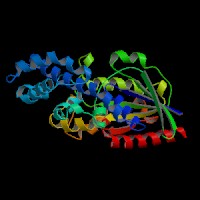
ModBase Predicted Comparative 3D Structure on P08754
Front
Top
Side
The pictures above may be empty if there is no ModBase structure for the protein. The ModBase structure frequently covers just a fragment of the protein. You may be asked to log onto ModBase the first time you click on the pictures. It is simplest after logging in to just click on the picture again to get to the specific info on that model.