Press "+" in the title bar above to open this section.
Comments and Description Text from UniProtKB
ID:AMFR_HUMAN DESCRIPTION: RecName: Full=E3 ubiquitin-protein ligase AMFR; EC=6.3.2.-; AltName: Full=Autocrine motility factor receptor; Short=AMF receptor; AltName: Full=RING finger protein 45; AltName: Full=gp78; FUNCTION: E3 ubiquitin-protein ligase that mediates the polyubiquitination of a number of proteins such as CD3D, CYP3A4, CFTR and APOB for proteasomal degradation. Component of a VCP/p97- AMFR/gp78 complex that participates in the final step of endoplasmic reticulum-associated degradation (ERAD). The VCP/p97- AMFR/gp78 complex is involved in the sterol-accelerated ERAD degradation of HMGCR through binding to the HMGCR-INSIG complex at the ER membrane and initiating ubiquitination of HMGCR. The ubiquitinated HMGCR is then released from the ER by the complex into the cytosol for subsequent destruction. Also acts as a scaffold protein to assemble a complex that couples ubiquitination, retranslocation and deglycosylation. Mediates tumor invasion and metastasis as a receptor for the GPI/autocrine motility factor. PATHWAY: Protein modification; protein ubiquitination. SUBUNIT: Interacts with RNF5. Also forms an ERAD complex containing VCP/p97, NGLY1; PSMC1; SAKS1 AND RAD23B required for coupling retrotranslocation, ubiquitination and deglycosylation (By similarity). Interacts with DRL1. Interacts (through a region distinct from the RING finger) with UBE2G2/UBC7. Component of the VCP/p97-AMFR/gp78 complex that enhances VCP/p97 binding to polyubiquitinated proteins for their degradation by the endoplasmic reticulum-associated degradation (ERAD) pathway. Interacts (via the VIM) with VCP/p97. Interacts (via its membrane domain) with INSIG1; the interaction initiates the sterol-mediated ubiquitination and degradation of HMGCR by the ERAD pathway. INTERACTION: P55072:VCP; NbExp=6; IntAct=EBI-1046379, EBI-355164; SUBCELLULAR LOCATION: Endoplasmic reticulum membrane; Multi-pass membrane protein. DOMAIN: The VCP/p97-interacting motif (VIM) is sufficient for binding VCP/p97 to form a complex capable of transfering VCP/p97 from the cytosol to microsomes. SIMILARITY: Contains 1 CUE domain. SIMILARITY: Contains 1 RING-type zinc finger. SEQUENCE CAUTION: Sequence=AAA36671.1; Type=Miscellaneous discrepancy; Note=Several sequencing errors; Sequence=AAA79362.1; Type=Frameshift; Positions=355, 388, 411, 487, 537, 583, 632;
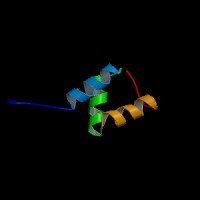
ModBase Predicted Comparative 3D Structure on Q9UKV5
Front
Top
Side
The pictures above may be empty if there is no ModBase structure for the protein. The ModBase structure frequently covers just a fragment of the protein. You may be asked to log onto ModBase the first time you click on the pictures. It is simplest after logging in to just click on the picture again to get to the specific info on that model.